When God Speaks, Will You Follow?
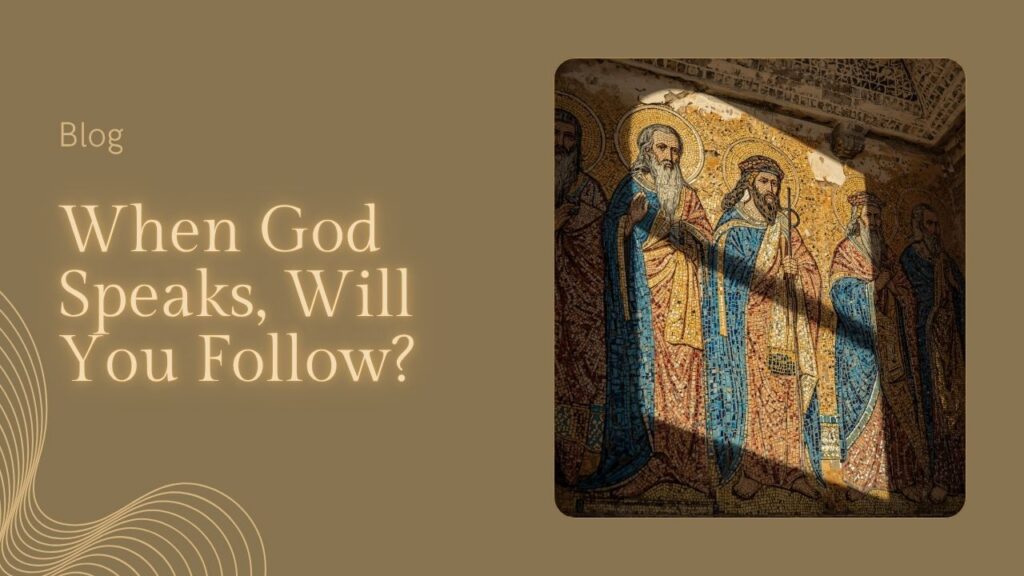
There is something that should stop us in our tracks if we think about it long enough. The Creator of the universe — the one who spoke galaxies into existence, who set the stars in their courses and carved out the depths of the oceans — pursues us. He speaks to us. He inserts himself into the ordinary moments of human life and calls people by name. That is not a small thing. In fact, it’s extraordinary when we realize that God speaks to us personally.
From the very first pages of Scripture, God has been a God who communicates. He walked with Adam and Eve in the garden. He called out to them even after they had turned away in rebellion. When sin fractured that perfect fellowship, God did not go silent. He pursued. He promised. And he has never stopped doing either. His voice continues to echo, reminding us that God speaks to those who listen.
This is the thread that runs through the great stories of faith we find in Hebrews 11 — that God speaks, and those who hear him and trust him find themselves swept up into a story far larger than anything they could have written for themselves. Recognizing that God speaks is key to understanding His will in our lives.
The Audacity of Abraham’s Obedience
Few stories in all of Scripture capture this dynamic more powerfully than the life of Abraham. When God called Abraham out of his homeland, the command was both simple and staggering. As recorded in Genesis 12, God told him to leave his country, his family, and his father’s house and go to a land that God would show him. There was no map. There was no detailed itinerary. There was only a voice and a promise.
And Abraham went.
Hebrews 11 describes this as obedience without full knowledge — he went out, not knowing where he was going. He left behind comfort, community, familiarity, and the security of an established life. He became a sojourner, a tent-dweller in a foreign land. By every human measurement, this was not a sensible plan. But Abraham was not operating by human measurement. He was operating by faith.
What makes Abraham’s story even more remarkable is the timeline. God promised him that his descendants would be as numerous as the stars in the sky and the grains of sand on the seashore — a promise recorded in Genesis 15. Abraham received that promise when he was already well advanced in years. He waited. He stumbled. He doubted. He tried to help God along in ways that only complicated things. And still, God was faithful. Isaac was born when Abraham was one hundred years old, twenty-five years after the original call. A quarter of a century of waiting, and God kept his word.
God’s Timing Is Not Our Timing
This is one of the most uncomfortable and yet most liberating truths embedded in Abraham’s story. God’s timing rarely matches our sense of urgency. We want answers today, clarity by tomorrow, resolution by the end of the week. God, it seems, plays a longer game. He sees the full picture when we can barely see what is directly in front of us.
The promise God made in Genesis 3 — that one would come to crush the enemy’s head — took thousands of years to be fulfilled. Yet it was fulfilled, completely and perfectly, in Jesus Christ. The long arc of God’s faithfulness does not bend toward disappointment. It bends toward completion.
When we trust God in seasons of waiting, we are not trusting a feeling or a circumstance. We are trusting his character — his goodness, his steadfastness, his proven track record across the whole of human history. That is a foundation that does not shift.
Strangers Looking for a Better Country
Hebrews 11 describes Abraham and his heirs as people who acknowledged they were strangers and exiles on the earth. They died in faith without having received the full realization of what had been promised. And yet they did not turn back. They refused to return to what was familiar because their desires were fixed on something eternal.
This is the posture of every believer. We are sojourners. We are exiles. The world around us is not our permanent home, and if something in you has always felt slightly out of place, slightly unsettled, slightly like you do not quite belong — that may not be a problem to be fixed. That may be a sign that you are exactly who God says you are: someone whose foundations are not built here, but in eternity.
The promise that Jesus makes in the Gospel of John is that the Father is preparing a place for those who belong to him. The sojourning is temporary. The home is permanent.
Learning to Hear
So how do we cultivate the kind of faith that hears and responds to God’s voice? A few things are worth considering.
First, ask. Jeremiah 33 records God’s invitation to simply call on him and he will answer. James writes that if anyone lacks wisdom, they should ask God, who gives generously. The starting point is simply asking God to speak.
Second, listen. This requires intentionality. Jesus regularly withdrew from noise and distraction to pray. The same discipline is available to us. Put down the phone. Step away from the noise. Create space for something other than your own voice to fill the room.
Third, spend time in God’s Word. Those who hear God most clearly tend to be those who know Scripture most deeply. God speaks in ways that align with what he has already revealed. Psalm 119 describes his Word as a lamp to our feet and a light to our path — and that lamp is always available.
Fourth, be obedient to what God has already said. Sometimes the silence we experience is not God being distant. It is God waiting for us to act on the last thing he told us.
Finally, test what you hear. Does it align with Scripture? Does it reflect the character of God — his love, his grace, his faithfulness? Seek the counsel of people who know the Word. God is not double-minded. He will not contradict what he has already revealed.
Not Ashamed
Hebrews 11 closes this section with a declaration that should anchor every heart: God is not ashamed to be called their God. He is not ashamed to be called your God. The Creator of the universe, who has pursued humanity across every generation, is still pursuing you. He is still speaking. The question is simply whether we are willing, like Abraham, to hear and to go.
This content was created with AI assistance based on a recent sermon preached at Cross+Crown and reviewed by church staff.