Longing for Forgiveness and Access
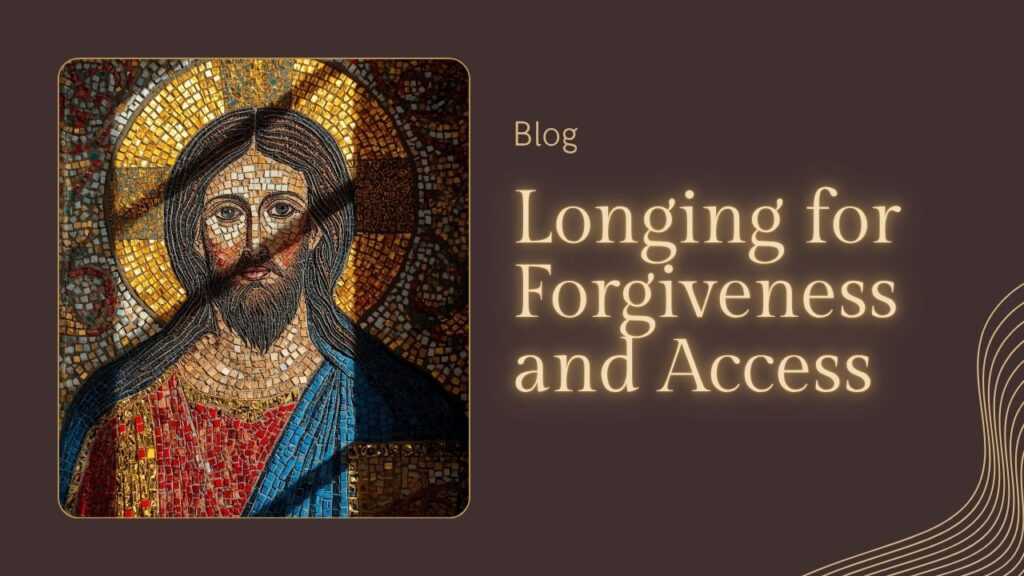
Deep within every human soul lies a profound longing—two desires so fundamental they shape our entire existence. The first is the desperate need to be free from the crushing weight of guilt and shame that accompanies our failures and mistakes. The second is equally powerful: the yearning to be fully known and yet completely loved.
These aren’t superficial wants. They’re not about material possessions or temporary pleasures. If we’re honest with ourselves, beneath every other desire we chase, these two longings pulse at the core of who we are. We want to be clean. We want to be close.
The Problem With the Old Way
The book of Hebrews addresses this ancient human dilemma head-on. Under the Old Testament system—the Levitical priesthood with all its laws, sacrifices, and rituals—something was fundamentally incomplete. The law provided a temporary covering for sin, but it couldn’t remove it. The sacrificial system offered relief, but not resolution.
Hebrews 10:4 delivers a stark truth: “It is impossible for the blood of bulls and goats to take away sins.”
Even more heartbreaking, the law couldn’t grant access to God. The temple structure itself illustrated this painful reality. There were courts for Gentiles, courts for women, courts for men, the holy place for priests—and then the Holy of Holies, separated by a thick curtain. Only the high priest could enter that sacred space, and only once a year.
Access denied.
Imagine living your entire life knowing that the God you worship, the Creator you long to know, remains perpetually out of reach. You could follow every ritual, offer every sacrifice, observe every feast—and still remain on the outside looking in.
Enter Melchizedek
To understand the revolutionary nature of what Christ accomplished, we need to understand a mysterious figure from the Old Testament: Melchizedek. This priest-king appears briefly in Genesis 14, blessing Abraham and receiving his tithe. What makes him remarkable is that he combined two roles that were always separate in Israel—priest and king.
The priests came from the tribe of Levi. The kings came from the tribe of Judah. Never the two shall meet. Whenever a king tried to assume priestly duties, disaster followed.
But Melchizedek was different. He was the “king of righteousness” and the “king of peace,” serving as both priest and monarch. And remarkably, he blessed Abraham—and the greater always blesses the lesser.
Psalm 110:4 prophesies that the Messiah would be “a priest forever, after the order of Melchizedek.” This wasn’t just poetic language. It was God’s announcement that a new kind of priesthood was coming—one that would accomplish what the Levitical system never could.
The Better Priest
Jesus Christ is that better priest. But His priesthood differs from the old system in every conceivable way.
The Levitical priests inherited their position through genealogy. You could be morally corrupt, but if you descended from Levi, you were in. Jesus, however, became a priest “not on the basis of a legal requirement concerning bodily descent, but by the power of an indestructible life” (Hebrews 7:16).
The old priests were temporary, limited by death. One generation would pass, and you’d hope the next priest was as faithful as his father. Sometimes he was. Often he wasn’t. Jesus, by contrast, “holds his priesthood permanently because he continues forever” (Hebrews 7:24).
The old priests were flawed humans who had to offer sacrifices for their own sins before they could address the sins of the people. Jesus was “holy, innocent, unstained, separated from sinners, and exalted above the heavens” (Hebrews 7:26).
What Perfection Really Means
When Hebrews speaks of “perfection,” it’s not talking about moral maturity or spiritual growth—though those matter. It’s talking about something more fundamental: complete salvation that grants both forgiveness and access.
“Now if perfection had been attainable through the Levitical priesthood…what further need would there have been for another priest?” (Hebrews 7:11).
The answer is obvious: perfection wasn’t attainable through the old system. The law “made nothing perfect. But on the other hand, a better hope is introduced, through which we draw near to God” (Hebrews 7:19).
There it is—the drawing near. The access we’ve always longed for.
Saved to the Uttermost
Perhaps the most stunning phrase in this entire passage is found in Hebrews 7:25: “Consequently, he is able to save to the uttermost those who draw near to God through him, since he always lives to make intercession for them.”
Saved to the uttermost. Completely. Fully. Utterly. From every sin, every failure, every curse, every attack. Not just saved once in the past, but continually saved in the present and guaranteed salvation in the future.
This salvation has three dimensions:
Past: We have been saved from sin’s guilt through Christ’s death on the cross. The penalty has been paid. The debt is cancelled.
Present: We are being saved from sin’s power through Christ’s ongoing intercession at the Father’s right hand. He advocates for us, transforms our desires, and progressively makes us more like Himself.
Future: We will be saved from sin’s very presence when Christ returns and establishes His eternal kingdom, where evil no longer exists.
Titus 2:11-14 captures this beautifully: “For the grace of God has appeared, bringing salvation for all people, training us to renounce ungodliness and worldly passions and to live self-controlled, upright, and godly lives in the present age, waiting for our blessed hope, the appearing of the glory of our great God and Savior Jesus Christ.”
The New Covenant
Jesus is the “guarantor of a better covenant” (Hebrews 7:22). This isn’t a contract based on the exchange of goods and services. It’s a covenant—a binding, sacred promise rooted in relationship and commitment.
Jeremiah 31 prophesied this new covenant: “I will put my law within them, and I will write it on their hearts. And I will be their God, and they shall be my people…For I will forgive their iniquity, and I will remember their sin no more.”
Full forgiveness. Complete access. This is what the human heart has always longed for.
The Curtain Is Torn
When Jesus died on the cross, the curtain in the temple tore from top to bottom. The barrier separating humanity from God’s presence was destroyed—not by human hands, but by divine initiative.
“Therefore, brothers, since we have confidence to enter the holy places by the blood of Jesus, by the new and living way that he opened for us through the curtain, that is, through his flesh…let us draw near with a true heart and in full assurance of faith” (Hebrews 10:19-22).
The invitation is clear: Come. Draw near. Access is granted.
The Love You’ve Always Wanted
Do you carry shame that keeps your head down? Do you fear that if people truly knew you, they couldn’t love you?
Here’s the stunning truth: there is One who knows you perfectly—every thought, every motive, every secret, every failure—and He loves you completely. Not despite knowing you, but while fully knowing you.
The cross of Jesus Christ accomplished what seemed impossible: it vindicated God’s justice while demonstrating His love, upheld His holiness while providing access, and satisfied His wrath while securing our forgiveness.
Forgiveness and access. Cleansing and closeness. Freedom from shame and the embrace of perfect love.
This is the gospel. This is what Jesus accomplished as our great High Priest. And it’s available to anyone who draws near.